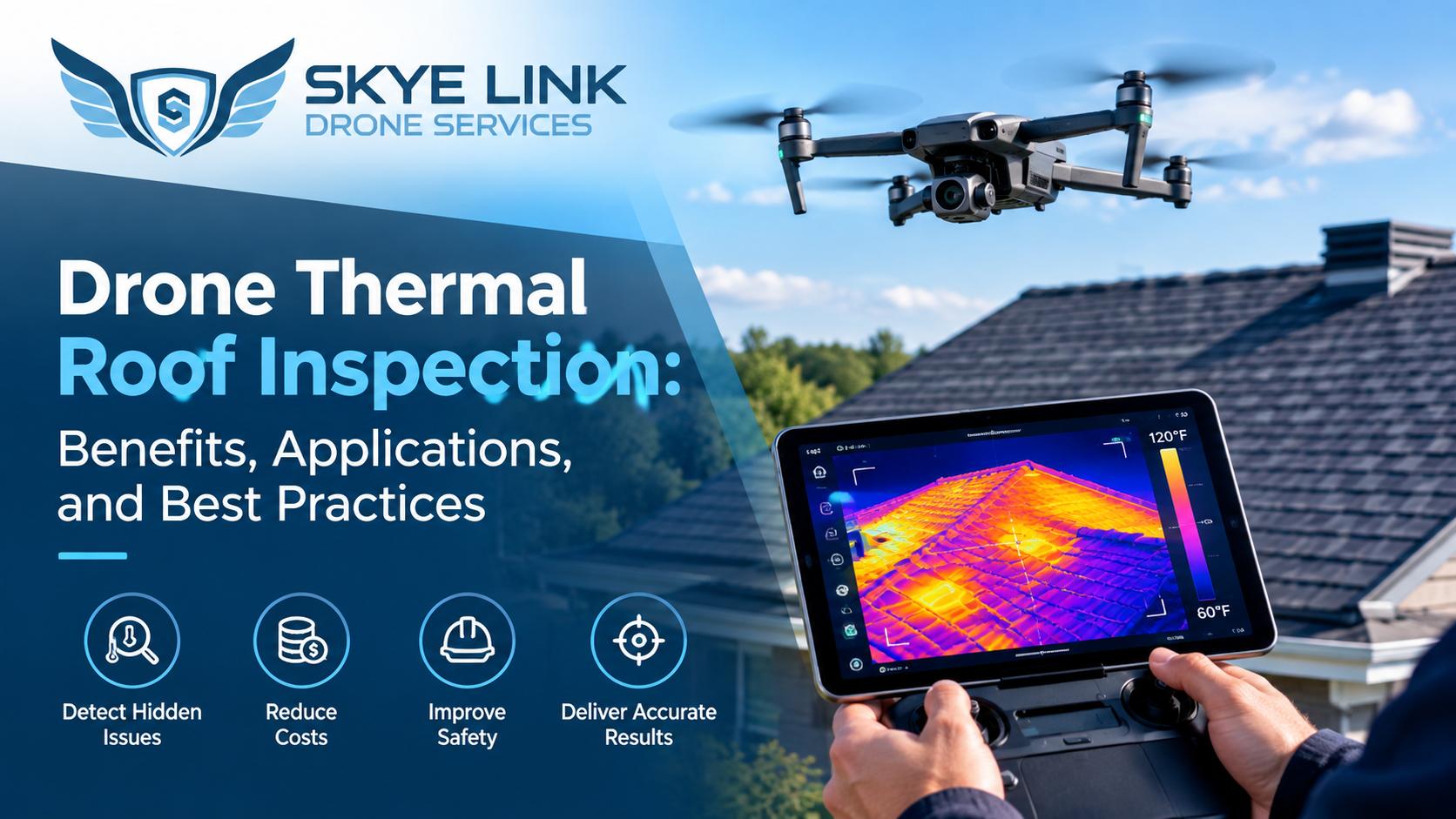


This guide explains how drone thermal roof inspection helps building owners, facility managers, and roofing contractors find hidden roof problems earlier, more safely, and at lower cost than traditional methods. You'll learn where it works best, what it can and can't detect, and how to get reliable results.
Most roof failures start out of sight. Water gets under the membrane, saturates the insulation, and spreads for months before a stain appears on a ceiling. By then, the damage is often larger and the repair more expensive.
Drone thermal roof inspection changes that. A drone fitted with a radiometric thermal camera flies over the roof and records heat patterns across the surface. Wet insulation holds heat differently from dry insulation, so problem areas show up as thermal anomalies. Inspectors can then confirm them with targeted checks instead of guessing or opening up the entire roof.
Did you know? A drone can survey a large flat commercial roof in a single short flight, with no one on the surface, no ladders, and no foot traffic on a membrane that may already be compromised.
Drone thermal roof inspection is the use of an unmanned aircraft equipped with an infrared camera to capture temperature patterns across a roof. It is usually combined with a high-resolution visual camera so every thermal finding can be matched to what the roof actually looks like.
It is most often used on low-slope and flat commercial roofs (TPO, EPDM, PVC, modified bitumen, and built-up roofing), where moisture hides beneath the membrane. It is also used on large industrial buildings, warehouses, schools, hospitals, and multifamily properties.
Materials heat up in the sun and release that heat after sunset. Dry insulation cools quickly. Wet insulation has more thermal mass, so it stays warmer for longer. A thermal camera picks up that difference, and the wet areas appear as warmer patches against the cooler, dry roof.
The general workflow:
Traditional Roof Survey : Drone Thermal Roof Inspection
Inspectors walk the entire roof : Aerial capture with no roof access needed
Slow on large roofs : Fast coverage of large areas
Moisture often found only after leaks appear : Hidden moisture and insulation issues flagged early
Foot traffic can damage weak membranes : No contact with the roof surface
Notes and scattered photos : Georeferenced maps and repeatable records
1. Safer inspections. Roof edges, skylights, and weak decking are real fall hazards. A drone keeps inspectors on the ground.
2. Earlier problem detection. Finding trapped moisture before it causes interior leaks or mold can extend roof life and avoid emergency repairs.
3. Targeted repairs. Instead of replacing a whole roof or cutting many exploratory cores, teams can focus on the areas that need attention. This often saves significant money.
4. Faster turnaround. Large roofs and multi-building portfolios can be assessed quickly, which helps with due diligence deadlines and maintenance planning.
5. Better documentation. Digital records make it easy to compare conditions year over year, support warranty and insurance claims, and share findings with contractors.
Thermal imaging is a screening tool, not a magic X-ray. It shows temperature differences at the surface and is best at revealing patterns that suggest moisture or insulation problems.
It works well for: trapped moisture in insulation, missing or compressed insulation, thermal bridging, and unusual heat around penetrations.
It has limits with: ballasted roofs and heavily reflective surfaces, very old debris-covered roofs, and roofs that were wet from recent rain. Some assemblies, such as metal roofs or those with thick gravel, are harder to read.
Findings should always be verified. Good providers say which anomalies are likely moisture and which need on-site confirmation.
Time it right. The best window is usually after a warm, sunny day, from late afternoon into the evening, when the roof is releasing stored heat. A clear temperature difference is essential.
Watch the weather. Avoid rain, fog, and high winds. Roofs generally need to be dry, often for a day or more after rainfall, and surface moisture or strong wind can distort thermal readings.
Use the right equipment. A radiometric thermal sensor with adequate resolution, paired with an RGB camera, gives both accurate temperature data and visual context.
Plan the flight. Use consistent altitude, appropriate overlap, and a grid pattern so images stitch cleanly and small anomalies aren't missed.
Account for surface variables. Emissivity, reflections from skylights and metal flashing, and shadows can create false readings. Experienced analysts recognise these.
Follow recognised standards. For roof moisture surveys, ASTM C1153 covers infrared imaging of roof moisture. Referencing it signals a rigorous process.
Stay compliant. Commercial operations in the US require a pilot certified under FAA Part 107, along with checks for airspace authorization, insurance, and site permissions.
Verify findings. Pair thermal data with core samples or moisture meter readings before major repair decisions.
Repeat regularly. Annual or post-storm surveys create a baseline that shows how conditions change.
Ask any provider:
Drone thermal roof inspection gives property owners a faster, safer, and more informative way to understand what's happening under the surface of their roofs. Done at the right time, with the right equipment and verification, it helps you catch moisture early, target repairs, and plan budgets with confidence.
If you manage commercial roofs, consider adding a thermal survey to your annual maintenance plan. Request a quote from Skyelink, a qualified drone inspection team to see what your roof is hiding.
It is an inspection method that uses a drone with a thermal camera to detect temperature patterns on a roof, helping identify hidden moisture, insulation loss, and other issues without walking the roof.
It can locate areas of suspected trapped moisture that often lead to leaks. The exact entry point usually needs confirmation on site.
Typically in the late afternoon or evening after a sunny day, when the roof releases stored heat and wet areas stand out.
It works best on flat and low-slope commercial roofs. Results can be limited on metal, heavily ballasted, or reflective roofs.
Many owners schedule annual surveys, plus extra inspections after severe storms or before buying or selling a property.



Discover how aerial thermal imaging helps businesses detect issues, improve inspections, reduce costs, and make smarter decisions in 2026.
Read article →
Explore the key benefits of using drones for utility inspections, from improved worker safety and accuracy to lower costs and faster results.
Read article →Share your project details and the Skye Link team will recommend the right scope, deliverables, and next steps - usually within 24 hours.
Your operating partner for managed drone data solutions, serving solar, utility, construction, engineering and commercial real estate teams nationwide.Visit skyelink.org
520 Elliot St, Suite 500, Charlotte, NC 28202
(704) 594-5177
contact@skyelink.org



.svg)